

Interview: Cesare Chiacchiaretta New Artistic Director of PIF Castelfidardo – Italy
April 24th 2026
Valentina Leone
interview is provided courtesy of Strumenti&Musica.com, author Valentina Leone, 18 April 2026
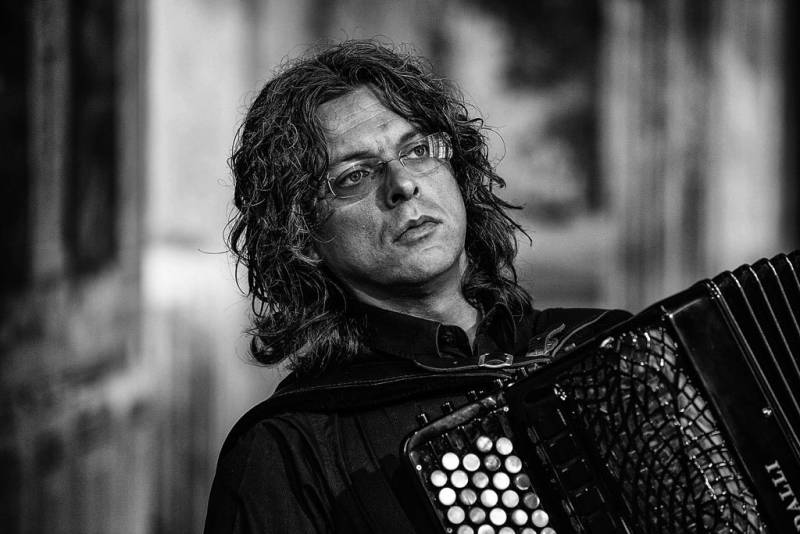
Introduction: With the change at the helm of the PIF Castelfidardo, the new Artistic Director Cesare Chiacchiaretta was announced in 2025. Cesare Chiacchiaretta is a well-known figure in the event’s circles, internationally, and, more generally, throughout the accordion movement. We had a long chat, trying to glean some insights about what lies ahead for the coming truly exciting years.
Cesare Chiacchiaretta continues a long tradition of having a prominent figure selected from amongst the well known attendees of Italian accordion schools, as an Artistic Director of the PIF Castelfidardo.
Q: You’ve had this experience as a competitor, a judge, and even a concert performer. What’s it like being on the other side of the fence?
A: It’s certainly a role with great responsibility. Personally, I approach this experience with great dedication and commitment because this is what the PIF requires. And it also requires respect and seriousness for its history. The people of Castelfidardo, the accordion industry (artisans, teachers, students), the Municipal Administration and my collaborators (from the secretariat to the ProLoco) expect a PIF that continues the quality and support it has enjoyed for fifty-one years.
There’s a lot of work to do, the commitment will be maximum, and we will strive to organize a high-level event. I was a competitor in the PIF, and in recent months I’ve traveled back in time to 1988, my first participation in the competition. I believe competitors deserve the best possible welcome, and it’s a duty to have a judging panel with the highest musical and accordion expertise.
Then, my mind went back to 2001, my first PIF as a juror, to the memory of my colleagues, their incredible expertise, and how difficult it was to judge such talented musicians. Finally, 2005, my first concert as part of the event, a thrill, with impeccable professionalism and organization. I hope to be able to do the same with this year’s artists.
Q: What’s special about PIF? There are many festivals around the world, but in Castelfidardo, you can sense a different atmosphere every day, and this undoubtedly increases your responsibilities. Do you have any specific ideas you’d like to develop during your tenure as Artistic Director?
A: The PIF is special because it’s an accordion event in the city of the accordion. What other instruments have a city that distinguishes them? Perhaps only Cremona and the violin. An event of this magnitude, dedicated to a musical instrument, in the city considered the accordion capital of the world, is something only accordionists can enjoy.
My goal is to continue the excellent work done by my predecessors, and my objective is to help the PIF winners enter the concert world. For this very reason, I’m inviting several entertainment management teams and working with the organizers of a series of major concert seasons to host the young people on their schedules.
Another goal is to hold high-quality concerts with established artists, which will involve not only soloists from various musical genres (from jazz to classical to popular), but also young and old who have won the PIF or are selected from among the world’s top performers.
Q: Castelfidardo can be considered, in all respects, a Mecca for accordionists. What kind of connection exists between the PIF and the local artisan businesses? Is there collaboration? Is it possible to establish a sort of constructive dialogue aimed at the event’s success?
A: The local artisan businesses welcomed me warmly, and I want to thank them publicly. Recently, I attended the AMMA meeting and had the pleasure of meeting the staff, along with President Marco Palmieri. I’m thrilled! I see a strong desire to grow the accordion movement, and we’re moving in the same direction. It’s truly important to build synergy among all the players in our community and we’ve already explored many exciting projects.
Q: In these cases, the political community, in addition to providing financial support, guarantees the event’s success. Because in Castelfidardo, you can’t just shrug your shoulders at everything that revolves around the accordion. From the late Mayor Mirco Soprani to the current administration led by Mayor Roberto Ascani, with the ever-present Assessore alla Cultura Ruben Cittadini… Is there unity of purpose? What are the obstacles to overcome, beyond the bureaucratic issues?
A: Roberto, Ruben and I have known each other for a few years. They gave me complete freedom and above all, they placed their trust in me, and I’m very honored. I believe that the PIF is the most important event for the Municipal Administration of Castelfidardo in terms of visibility, so they helped me when I made specific requests and are working on both financial and bureaucratic arrangements to facilitate my artistic direction. They are also always available for any need, and I assure you that the challenges of managing an event of this magnitude are truly numerous.
Q: You’ve dedicated much of your career to establishing the accordion in cultured and academic circles. Where are we in this process of “ennobling” the instrument, and how do you assess the development of new musicians?
A: I truly appreciate what young accordionists are doing. They’ve integrated themselves very well into some major concert seasons and have managed to secure positions with top-notch arts promotion agencies. Some have even won the PIF in the past, including Samuele Telari and the Sirius Accordion Trio, to name a couple. Nowadays, the prospect of an accordion concert in concert halls and on the program schedules of major seasons is no longer the unattainable goal it was a few years ago. In my opinion, these organizations are much more open to including the accordion in their programs, and we must take action to ensure our instrument continues its steady rise.
Q: What do experiences like the PIF leave in the cultural and emotional baggage of the young people who take part?
A: Personally, I’ve always felt like a “child of the PIF.” It’s an experience I recommend for every accordionist, and having had the honor of winning the Award in 1993, has defined my entire career. I felt compelled to confirm and honor this victory. If I’m the PIF Artistic Director today, I believe part of the credit goes to my name being engraved in the event’s Roll of Honor.
Q: What’s new in this 51st edition of the PIF Award? What are the categories?
A: There will be two new categories (Jazz and Piazzolla); the remaining categories will remain unchanged (World Music for Accordion and Folk Music, Virtuoso, Classical, Chamber Music, and Accordion Orchestra). I’m pushing hard for these last two categories because the level of accordion orchestras has risen significantly in recent years, and because I’m convinced the accordion has an important place in chamber music. If we think about it, it’s perhaps the only “portable” instrument, along with the guitar, that can be played in a duo with a variety of musicians, including violinists, flutists, and so on.
Q: Can you already tell us the names of some of the teachers or musicians who will be part of the various juries?
A: Absolutely not! However, I can guarantee that they will be top-level musicians, coming from all over the world and specialized in the various categories. Certainly, no jury members will be forced to abstain from voting because their students are competing in the same category. Everything will be transparent, professional, and final. I hope for a discussion between the participants and the jury members at the end of the auditions; I don’t like mere numbers that lack objective motivation, and so I would like the competitors, for the sole purpose of learning and improving, to seek advice from the judges.
Q: As for concerts, what’s cooking?
A: I can only say that there will be evening concerts at the Teatro Astra: folk music, jazz, baroque music, and soloists with a symphony orchestra; afternoon concerts with the best young musicians around, both soloists and duos and trios; and finally, big names for the concerts in Piazza del Comune. I want it to be a PIF with the best exponents of our instrument. For some, it will be a return after several years of absence, for others, it will be their first time. I can’t give any further details at this time.
Q: Is there, in your opinion, an artist who, more than others, has left a mark during the various editions of the Festival?
A: Of course, yes. Maybe more than one. I can mention Frank Marocco. I can’t tell you about the others because you’ll see them live on September 12th and 13th.
Q: We were saying, in fact, that there are many initiatives in various countries that feature the accordion, often in contexts other than that of Fidenza. Do you think the conditions are right for teamwork, forging partnerships that are beneficial to the respective organizations?
A: I’ve already spoken with my friends Igor Krizman and Anibal Freire, who organize important competitions. I’m obviously in touch with the President of the Coupe Mondiale, Mirco Patarini, as well as with representatives of the Trofeo Mondiale and Inaki Alberdi of Harrasate. I believe that collaboration must be sought and can be achieved. Some of them will host the PIF winner for a concert as part of their respective events.
Q: There’s a lot of talk about electronic music and artificial intelligence (AI)… What should we expect from AI for the future of the accordion? How do you view the advent of technology and, above all, do you think it can shape the educational process of young people, the way they compose and present new music?
A: I’m not a big believer in the use of AI in music. What for? Compose songs? I prefer not to listen to them. However, technology can help a lot. Just think of the use of tablets instead of music stands and countless pages of music. Or the technology applied to the accordion mechanism (a company in Castelfidardo has brilliantly developed this idea). I believe, instead, that the educational process of young people should be based on “analog” study: commitment, effort, perseverance. I’m against shortcuts in music education.
Q: Was PIF, as an Artistic Director, a dream you’d had in your heart, or were you “dragged into it”? What are your short to medium-term goals?
A: Honestly, I’ve never considered the Artistic Director role. As a visitor/participant of the PIF, I’ve occasionally blurted out, “Why do they do these things at the PIF?” I admit it… However, now that I’m involved first-hand, I’ve taken criticism into account, which will undoubtedly help me improve.
My goals for this year? A sufficient number of competitors, a high level of participation and effective promotion of the accordion, both for children/teenagers (to this end, I’m organizing some interesting initiatives in collaboration with the Scuola Civica di Musica del Maestro Giaccaglia and accordion teacher Maestro Luigino Pallotta) especially for those who have never heard it played live. And I assure you, there are many.
Q: In closing… Is there a figure who has influenced your artistic development or who has simply fascinated you more than others? Which accordionists, past or present, would you have liked to bring to the stage at the Astra or in Piazza della Repubblica?
A: I can tell you that Mogens Ellegaard has influenced me greatly, but there are also references like Frederich Lips, who I must also mention. As well as my deep admiration for Vladimir Zubitsky. Who would I like to see on the Astra stage or in the square? I assure you, I’ve already contacted them, and my wish will come true from September 9th to 13th, 2026.


