Sofia Gubaidulina (24 October 1931 – 13 March 2025) stands as one of the most innovative and profound composers of the 20th and 21st centuries, whose music bridges the realms of spirituality, mysticism, and avant-garde exploration. She passed away at her home near Hamburg, Germany at the age of 93.
Born in 1931 in the Soviet Union, she defied artistic constraints to develop a deeply personal style, often drawing upon religious symbolism, unusual instrumental techniques, and rich, evocative textures. Among her numerous contributions to contemporary music, her work for the accordion and bayan has been particularly transformative, elevating these instruments to new heights within the classical and avant-garde repertoire.
Gubaidulina’s fascination with the Bayan, the Russian chromatic button accordion, was rooted in its expressive potential and timbral richness. She saw in it not just an instrument of folk tradition but a medium capable of profound depth, capable of whispering ethereal sonorities or erupting in cataclysmic power. Her compositions for bayan and accordion are deeply personal and philosophical, exploring themes of contrast—light and darkness, chaos and order, suffering and transcendence.
Notable compositions for the accordion include:
- De Profundis for bayan (1978) – dedicated to Friedrich Lips
- Seven Words – Cello, Bayan, and Strings (1982) – dedicated to Friedrich Lips and Vladimir Tonkha
- Et Exspecto, Sonata for Bayan (1986) – dedicated to Friedrich Lips
- Silenzio: Bayan, Violin, and Cello (1991) – dedicated to Elsbeth Moser
- In croce: for cello and organ (1979) or bayan and cello (1991) – dedicated to Vladimir Tonkha
- Tartarische Tanz for bayan and two contrabass (1992) dedicated to Viktor Suslin
- Galgenlieder à 5: Mezzo-soprano, Flute, Percussion, Bayan, and Double Bass (1996)
- Under the Sign of Scorpio: Variants on Six Hexachords for Bayan and Orchestra (2003)
- Fachwerk: Concerto for Bayan, Percussion and Strings (2009) – dedicated to Geir Draugsvoll
- Cadenza: (2003) edited by Iñaki Alberdi (2011), from Under the Sign of Scorpio
- Concerto for violin, cello and bayan (2017) – dedicated to Elsbeth Moser
One of her most significant works for the bayan is De Profundis (1978), a masterpiece that showcases the instrument’s extraordinary range of expression. The title, meaning “Out of the Depths,” references Psalm 130 and conveys a journey from despair to spiritual awakening. Through unconventional techniques such as cluster chords, glissandi, and dynamic extremes, Gubaidulina crafts a sonic landscape that feels both intimate and cosmic.
Another seminal work is Et Expecto (1986), which continues her exploration of faith and metaphysical themes. This piece, with its stark contrasts and intense emotional pull, is an outstanding example of how the bayan can transcend its traditional roles, becoming an instrument of deep philosophical inquiry.
Tribute from Friedrich Lips
In Memory of Sofia Gubaidulina
On March 13, on the way to the Gnessin Academy in the metro, I received sad news.
During the entire journey, tears rolled down my cheeks. I did not cry, the tears just flowed without stopping and were as natural as human breathing. A kaleidoscope of events related to our 50-year communication flashed through my head. I remembered how in the spring of 1975, Sofia Asgatovna supported the young composer Vladislav Zolotarev, whose Third Sonata I played at the Union of Composers in front of the commission in connection with Zolotarev ‘s entry into the Union of Composers. At the end of the meeting, Gubaidulina came up to Vladislav and me and warmly congratulated us.
Naturally, I did not fail to ask: ‘Sofia Asgatovna, would you like to write something for the bayan?’
She replied that she would be happy to write, but did not know the capabilities of the instrument. We agreed to meet, and since then our communication has grown into a creative and human friendship.
I remembered what the reaction was to the first performance of De Profundis, how higher authorities forbade me to perform it on a tour of Scandinavia organized by Mogens Ellegaard. But I got permission. I was young. If they had not allowed it, I would have played an encore. Although there could have been consequences. I remembered how on the premiere poster, instead of: ‘Seven Words’ it was written: ‘Partita in 7 parts’.
Religious themes were condemned, but Sofia did not pay attention to the condemnation of her work in the reports of the Union of Composers. As she said: ‘When it was impossible to write on religious themes, I wrote. When they allowed it, everyone started writing. And I started writing about secular subjects. I can’t do it like everyone else.’
When she was reproached for the “incorrectness” of her music, Shostakovich sent her a letter of support: ‘I continue to advise you to follow your “incorrect path!’
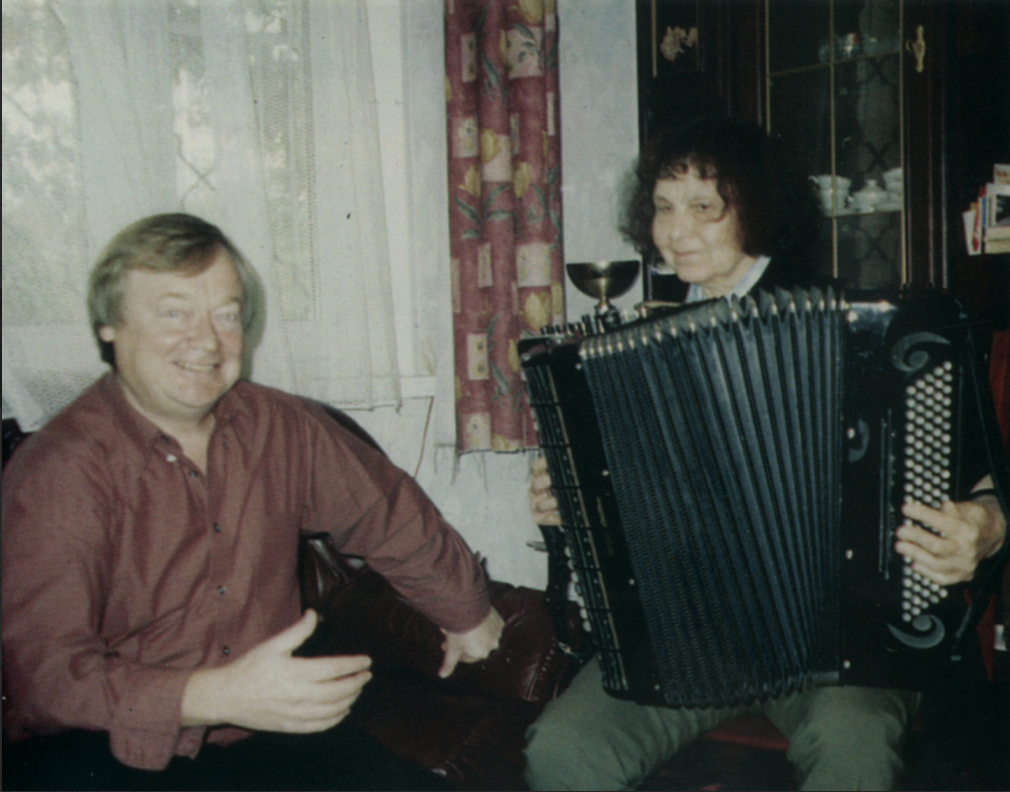
I remembered how, when writing the Sonata Et Exspесto, Sofia was at my house, and after demonstrating all types of ricochet, I put the accordion on her knees and she, like a girl, began to extract sounds from it with passion.
I remembered our creative communication at the Gidon Kremer Festival in Lockenhaus in Austria. She was unhappy with the cadenza in Silenzio and asked me to record my version, which she heard in the concert. I recalled her passionate work on the Concerto ‘Under the Sign of Scorpio’, when the deadlines were pressing and she sent me fragments for editing. And what a phenomenal reception she received in the Great Hall of the Moscow Conservatory after the performance of Fachwerk! The packed hall gave the author a standing ovation for several minutes as she came on stage!
I want to emphasize the main thing: it was Gubaidulina’s music that brought the accordion to the largest halls in the world. Personally, I had the opportunity to play her music in the Great Hall of the Tchaikovsky Conservatory in Moscow, in the Concertgebouw in Amsterdam, De Doelen in Rotterdam, Suntory Hall in Tokyo, Lincoln Center in New York, Washington Center in Washington, Barbican Hall in London … Gubaidulina’s music is performed by leading bayanists, accordionists, violinists, cellists, as well as the largest orchestras and conductors. No composer in the world gained such genuine interest and respect for her compositions related to the accordion! She has repeatedly emphasized that her favorite instruments are the cello and the accordion. The accordion, which, by her own admission, breathes!
To the question of the correspondent – is she afraid of leaving this life, Sofia answered:
‘No. It seems to me so solemn!’
Dear Sofia Asgatovna! The world is grateful to you for your extraordinary, inspiring creativity, unlike anyone else! The accordion world honours you and your music for your special love for us, and in my life, communication with you is one of the most significant and memorable periods of life!
Ars longa vita brevis. Rest in peace…
Friedrich Lips
16.03.2025