MUK (Musik und Kunst Privatuniversität der Stadt Wien) Gala Accordion Concert – Austria
December 6th 2024
Dr Herbert Scheibenreif Manager of Friedrich Lips Productions
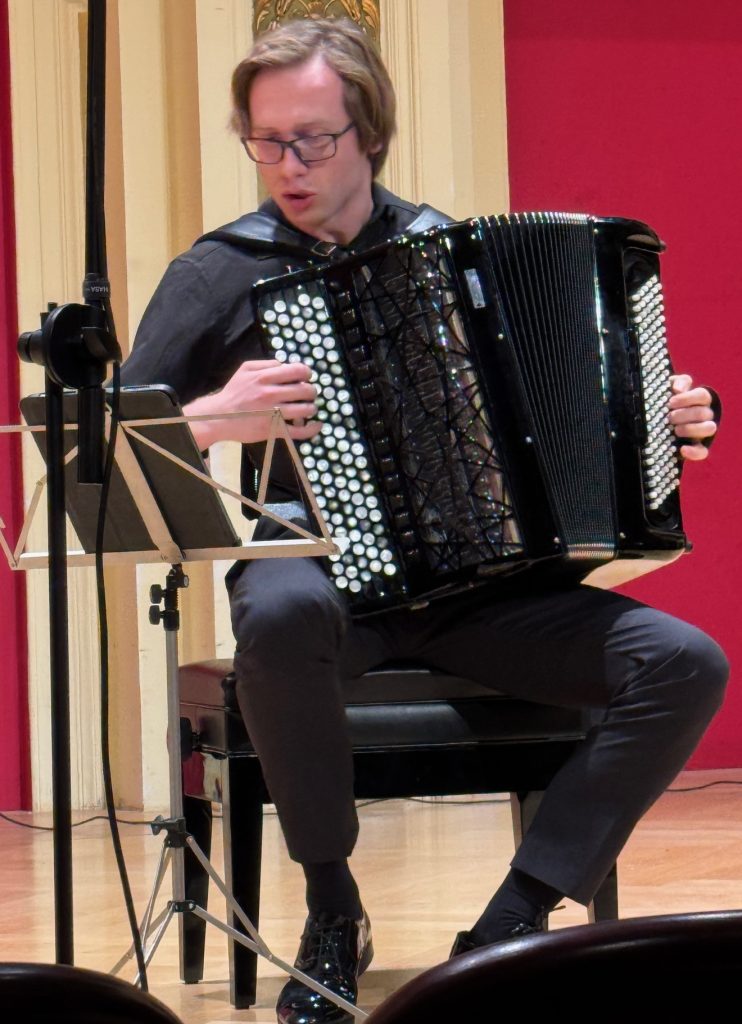
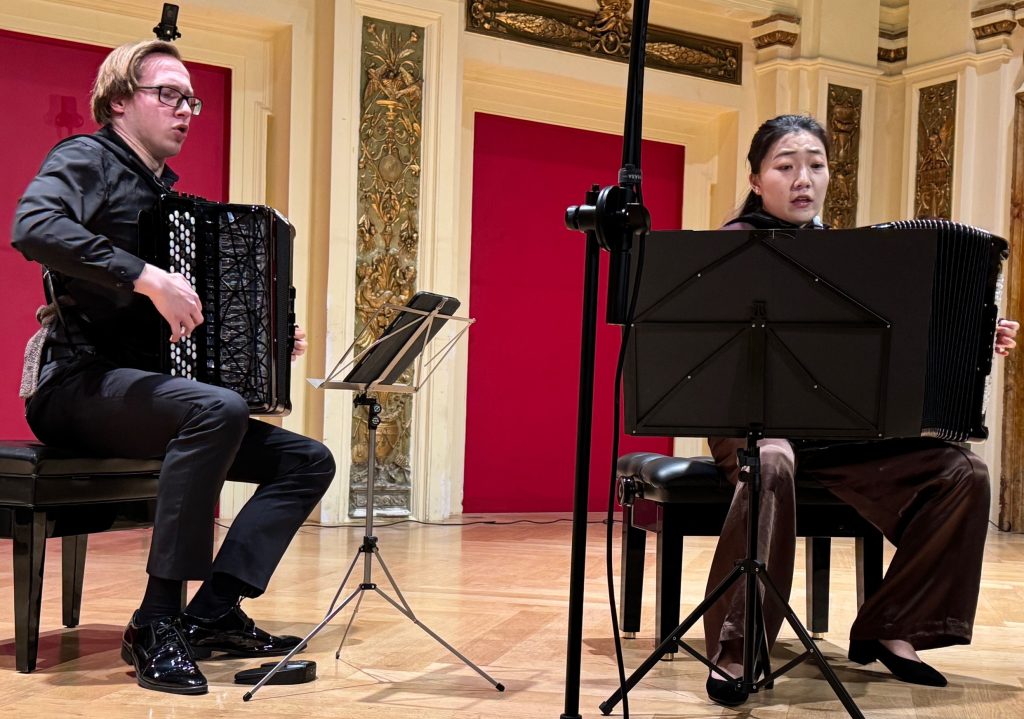
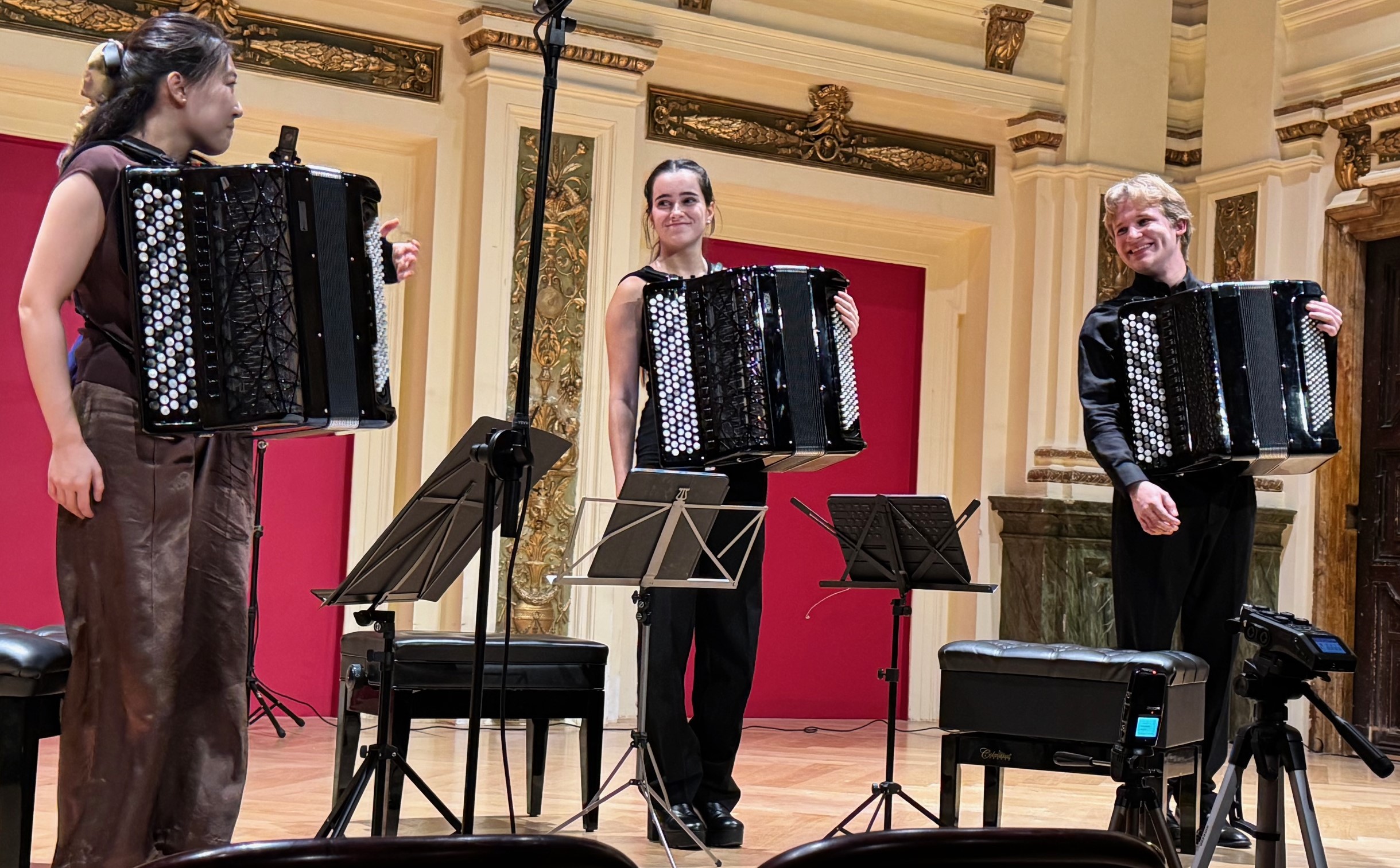
This week, students from Prof. Grzegorz Stopa’s accordion class and their chamber music partners from the Music and Arts University of the City of Vienna offered a program whose acoustic perspective changed again and again – through the combination of historical works with contemporary music, through various chamber music ensembles, as well as through the fascinating sound spectra of the instrument in the magnificent acoustics of the Ehrbar Hall. In addition to treasures from past eras, there were also new works by MUK composers to hear. Among the participating artists are also winners of the most important international competitions for classical accordion in Arrasate, Klingenthal and Castelfidardo.
The “Concerto in D minor BWV 1052”, composed in Leipzig between 1730 and 1733, is the best-known harpsichord concerto by Johann Sebastian Bach and may also be considered his most “typical” harpsichord concerto in terms of playing technique, but it probably goes back to a violin concerto in the same key from Bach’s time in Köthen (1717-23). The comparison of different versions was particularly attractive and exciting, especially since the 1st movement was presented in the arrangement for two pianos and the 3rd movement with strings, with the two accordionists Jingyang Wang and Piotr Motyka very impressive in both versions.
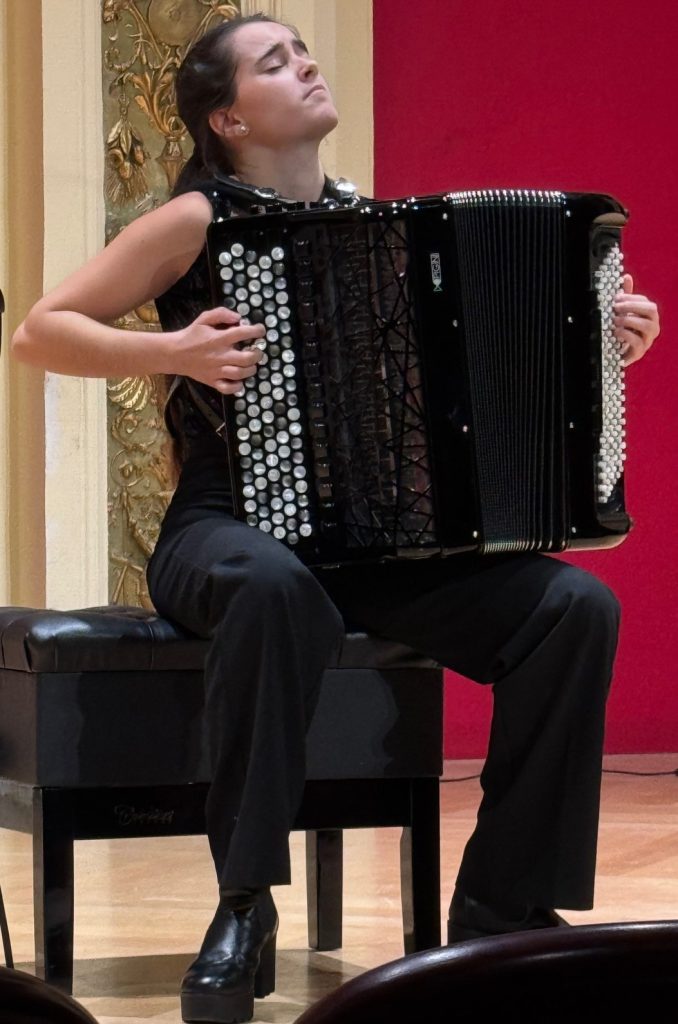
Krzysztof Penderecki is considered one of the leading composers of the Polish avant-garde, whose music helped shape the compositional style of an entire era of contemporary music. His “Sinfonietta” was transcribed for accordion by Maciej Frąckiewicz and performed masterfully by the Spanish accordionist Marta Cubas Hondal.
Isabella Leonarda’s “Sonata Duodecima” for solo violin and basso continuo was a work from the 17th century and was performed in a transcription by Sophia Schambeck and Elisabeth Müller.
Wolfgang Amadeus Mozart’s “Fantasy No. 4 in C minor, KV 475” is considered one of Mozart’s best-known fantasies and, like many of his piano compositions, extremely demanding. The autograph of the fantasy was discovered by a librarian in Philadelphia only in 1990. The manuscript came into the possession of the International Mozarteum Foundation via Sotheby’s. His “Serenade in C major, KV 648 Eine ganz kleine Nachtmusik” had its premiere at this concert in the version for string trio and accordion by Alessandro Zerilli. The interpretations of both works by Sophie Herzog and Jingyang Wang can already be seen as exemplary for future performances.
Steve Reich is considered a typical representative of minimalism. “Six Pianos” was created in 1973 and was originally intended to be written for all the pianos in a piano shop, but the sound was too compact, so Reich limited himself to 6 pianos. When 6 pianos are tuned to each other, an unpredictable effect occurs that no mathematics can predict (chaos theory). Each instrument has its own tone. Together they form a uniform sound that sounds different every time other instruments are tuned. If 6 accordions play together, a similar effect occurs due to the often not entirely precise tuning of the individual instruments. Konstantin Kozyrev, Katerina Tumova, Igor Filipovic, Kiia-Maria Katariina Piispa, Kiara Janko and Elisabeth Müller dared to conduct this sound experiment.
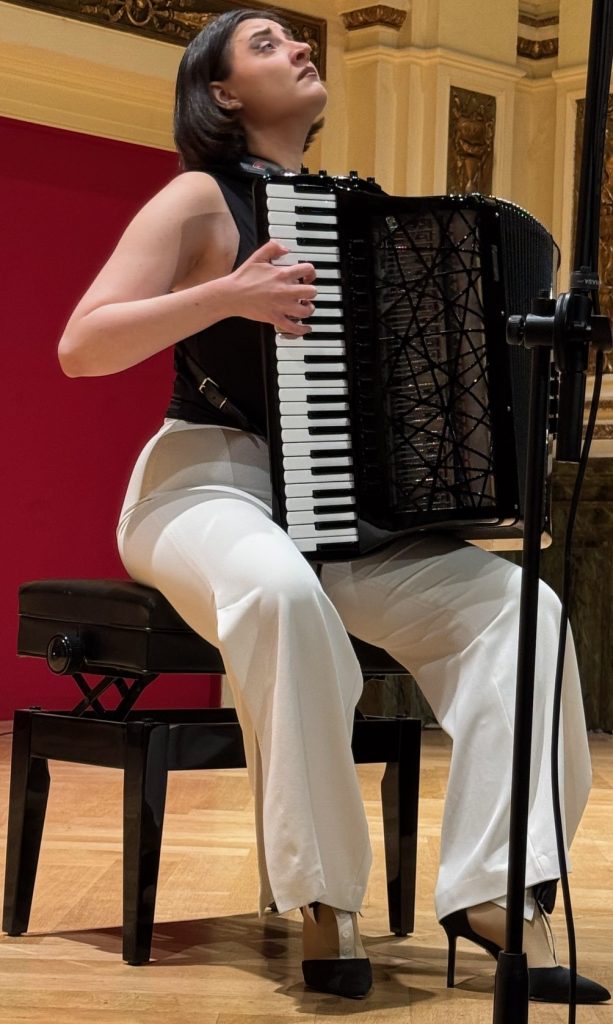
Inspired by the novel La orgía by José Más, Danzas fantásticas, Op. 22 is the best known work of Spanish composer Joaquín Turina. It was originally written for solo piano in 1919 and later orchestrated. Thanks to Marta Cubas Hondal, a transcription and excellent interpretation for accordion now exists.
Olli Virtaperko’s The Devil’s Lungs was inspired by the fact that the accordion as an instrument was until recently considered “promiscuous” in religious, God-fearing Finland. With its strong links to secular folk and dance music, the accordion was undoubtedly a dangerous weapon for “the devil”. The instrument brought with it an inappropriate and seductive aura; in fact, some parishes still do not allow accordions to be played in church today. For a secular composer of the modern world, however, the accordion is just an instrument – a very interesting one with many fascinating musical and technical possibilities, of which the accordionist Piotr Motyka made ample use.
Camille Saint-Saëns’ “Danse Macabre Op. 40” exists in a variety of versions – from the outstanding pianist Vladimir Horowitz to the accordion trio Symmetry from St. Petersburg. Jingyang Wang, Marta Cubas Hondal and Konstantin Kozyrev enchanted their audience with their playing and provided the crowning conclusion to an unforgettable concert evening.
Related stories
-
Marta Cubas Hondal: MUK Young Artist Presents “Songs of the Earth” Concert – Austria
Marta Cubas Hondal, MUK Young Artist will presents her "Songs of the Earth" concert at the Palais Ehrbar, Small Ehrbar Hallin Vienna, Austria
> More Stories