


Carmela Stefano explores the accordion in all its worlds: from Baroque to contemporary music, from opera to film soundtracks. For her, the instrument breathes like an orchestra and speaks with every musical genre.
In this interview, she retraces her journey: from her childhood beginnings to Conservatory studies, through collaborations with major conductors and composers, all the way to her teaching work. A story of music, passion, and discipline, revealed note by note.
And now, let her share her experience through the interview answers.
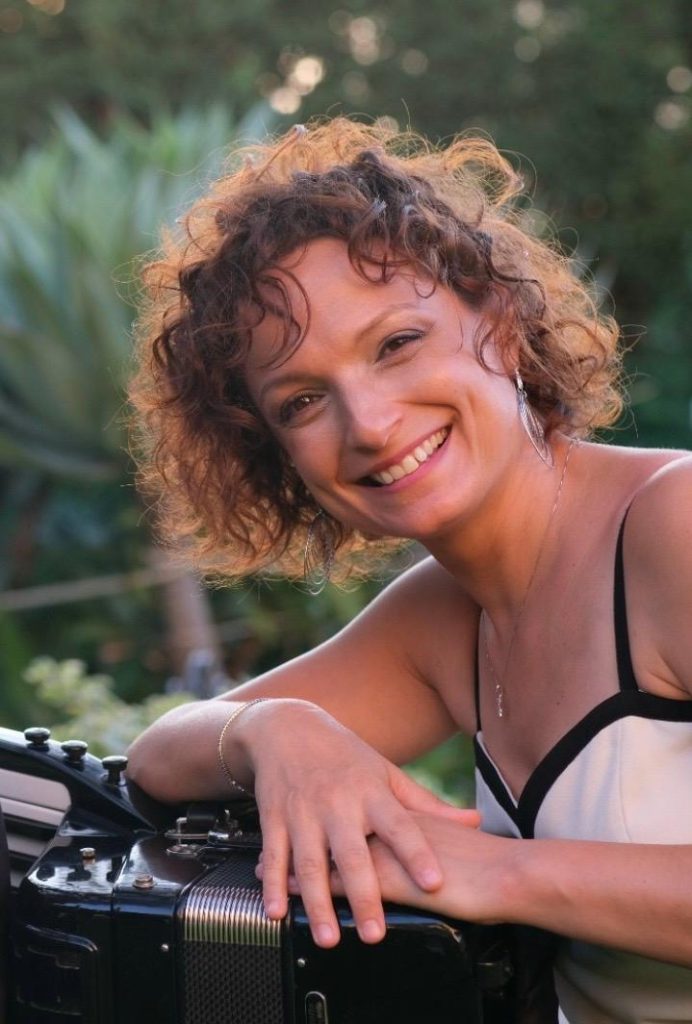
1. Let’s start from the beginning. You started playing the accordion at just seven years old, almost for fun, but you immediately showed an extraordinary talent. Looking back, when was the moment you truly felt that the accordion would become your lifelong companion? Was there a particular anecdote, a concert, or maybe someone who made you say: “Yes, this is my path”?
Yes, that’s exactly how it went: I started playing the accordion for fun, thanks to my father who, when I was seven, gave me one that he bought from a relative visiting Sicily from Australia. My father, who had always wanted to study music but never had the chance, was my first supporter: it’s thanks to him that I entered this world. The first real turning point came when I was eleven, when the simple “game” became a more serious and conscious commitment, and I faced my studies with consistency and responsibility. It was a long and not always easy journey: by eighteen I had already considered quitting twice, discouraged by the difficulties. I was still a young girl, and I often found myself giving up carefree moments with my peers, such as school trips, breakfasts with friends, and afternoons spent together, in order to devote myself entirely to my studies. My lessons were private, individual, without the chance to share that experience with other kids my age.
I truly realized that the accordion would be my path at twenty-one. After graduating high school (Commercial Institute) and already completing my Accordion diploma at the “Cherubini” Conservatory in Florence in 2000, I received an offer for a temporary teaching position as an ITP (Technical Practical Teacher) in Treviso. It was then that I understood I was willing to make important choices only for music: I decided not to accept the position and to continue my musical training. I enrolled in the Music Education program at the Conservatory of Messina, while also continuing my Law studies at university. Only music, I realized then, deserved my full dedication.
2. You were born in Switzerland, studied in Florence, and now teach and perform throughout Italy and abroad. How much have these places, these different atmospheres, influenced your artistic development? Is there a city or a theater where, even today, you feel truly “at home” when you walk on stage with your accordion?
The truth is that I don’t feel tied to any specific city: I feel well everywhere, because the stage is what makes me feel at home.
3. For many, the accordion is almost an extension of the player: some choose it for its tone, others for mechanical response, others for versatility. What is your reference accordion today, and what convinced you to prefer it? Are there any particular features – in the registers, construction, or sound – that you consider essential for performing such a wide repertoire, from Bach to contemporary music?
For me, the accordion is a true orchestra, and that’s exactly what fascinates me most. It allows me to explore different sound worlds, moving naturally from one genre to another simply by choosing the most suitable registers for the piece I’m playing. Every register, every timbral nuance opens new expressive possibilities, and this versatility is what makes me feel deeply connected to the instrument.
4. Your repertoire, as we said, ranges from the Renaissance to contemporary music, including monumental works like J.S. Bach. When preparing a concert program, what criteria do you follow? Do you prefer to build a philological path, or do you enjoy mixing eras and styles to surprise the audience?
My repertoire spans a wide range, from Baroque to contemporary music. Even though the accordion is often perceived as an instrument tied to folk festivities, I firmly believe that it is much more than a folkloric symbol. I don’t deny traditions at all, but I feel the desire to contribute to the modernity and full dignity of this unique instrument.
For this reason, in my concert programs I almost always begin with Baroque music (Bach, Frescobaldi, Scarlatti) because I believe that’s where one can elevate the perception of the accordion and the accordionist: a noble instrument capable of interpreting classical music with the same depth and rigor as any other classical instrument.
Mine is, in essence, a true mission: to reveal the new face of the accordion.
5. Throughout all these years of study and concerts, I imagine your approach to the instrument has changed. How do you approach your daily practice today? Is there a technical or musical aspect you like to revisit regularly, perhaps to rediscover the accordion under new shades?
I try to listen to myself. And it’s precisely the way I listen to myself that has changed over time: the experience I’ve gained makes me more critical of myself. Today I’m more attentive to technique, the elegance of sound, and above all, I give fundamental importance to the use of the bellows, which I consider the true lungs of the instrument.
Music, for me, goes beyond playing the notes: musical maturity allows me to work a lot with my mind, elaborating and naturally shaping the interpretation. This allows me to create an immediate and personal musical idea, unique in its nature.
6. Bach’s repertoire is now a cornerstone even for classical accordion, but interpreting it in a personal way is never taken for granted. When working on pieces like The Well-Tempered Clavier or the Partitas, what musical or timbral aspects do you focus on most? Do you use particular registers or solutions to best express articulation and contrapuntal clarity?
For me, Bach is everything: he is the beginning and the end in the complexity of a musician. He is formative because he is discipline, and discipline allows one to approach all other musical genres, even contemporary ones. Bach is the fundamental foundation, he is school. When I work on one of his pieces, I always begin with structural analysis: once I understand the structure, I give space to my inner perception, shaped by the intense work I’ve dedicated to this composer. I build my interpretation of Bach each time by reading the author’s thought in the various melodic phrases; from there I choose the timbre (registers), dynamics (sound intensity), and the emotions to express.
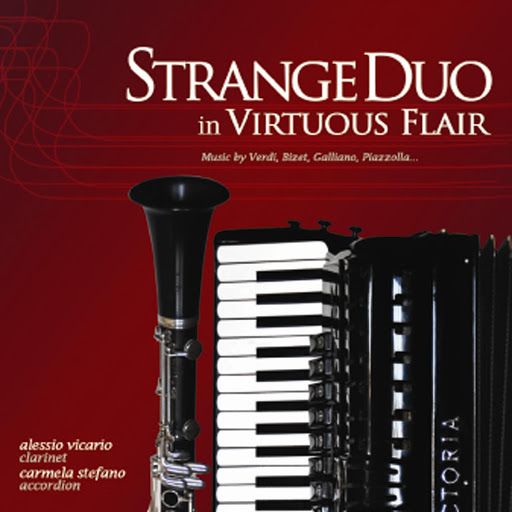
7. In 2011, together with Alessio Vicario, you founded the Strange Duo for clarinet and accordion — a combination that offers truly unique timbral possibilities. How was this project born, and what sound exploration guides you? Are there composers or arrangements you feel particularly connected to, or that were created specifically for your duo?
The project was born in 2011 at the Teatro Massimo in Palermo, where I was hired for the opera The Greek Passion by Martinů, in which I performed several on-stage solo passages. It was there that I met Alessio Vicario, then principal clarinet of the theater. Alessio, who had long wanted to create a project with accordion, heard me play and asked if I would try forming a unique duo, performing mainly operatic pieces already transcribed for clarinet and piano and adapting them to our instrumentation. Opera music was not naturally part of the accordion repertoire, but the challenge intrigued me immediately. Alessio believed that introducing the accordion in place of the piano would give the arrangements a new form: the accordion not only creates an almost orchestral backdrop for the clarinet but interacts with it in the lyrical passages, approaching the original operatic structure. That’s how the Strange Duo was born — “strange” not for the pairing of instruments, but for the choice of repertoire.
After our first concerts, we became a source of inspiration for several contemporary composers. Among them, Joe Schittino, a renowned Sicilian composer, dedicated JS173 Variations on Musetta’s aria from Puccini’s La Bohème, published by F. Hofmeister Musikverlag in Leipzig. This piece was later included in our two albums In Virtuous Flair 1 and 2 for the Austrian label Pro Cultura. Alberto Caputo, a talented emerging Sicilian composer, also took an interest in us, dedicating two compositions — Strange Dream and Wandering Thoughts, published by the Italian label Eufonia.
Moving from opera (Verdi, Puccini, Rossini) to Richard Galliano, in fourteen years of activity we have performed in Italy and abroad, always receiving enthusiastic feedback from both audiences and critics.
8. Working with I Solisti del Sesto Armonico conducted by Beppe Vessicchio and with conductors like Luis Bacalov, Nicola Piovani, and Franco Piersanti has exposed you to very different musical languages. What has playing in an orchestra or mixed ensembles taught you in terms of listening and interpretation? Do you think this influences the way you approach the accordion as a chamber or symphonic stage instrument?
Absolutely. I learned how to blend and balance my sound with the other instruments. I approached many musical genres different from those typically studied in academia, adjusting my timbre each time. In these contexts, I performed pieces I never imagined playing: pop music, film soundtracks, Argentine tango. Each time it’s a new adaptation, one in which I always find myself with enthusiasm and emotion. Working with great conductors allowed me, on one hand, to refine my ability to integrate harmonically with other musicians; on the other, it gave me greater awareness and confidence as a possible soloist.
9. More than thirty years of concerts, recordings, tours in theaters and even archaeological sites like Taormina or Selinunte: after all this time, what do you feel when you step on stage? Is the emotion the same as your debut, or has it changed? Do you have a ritual you repeat before each concert?
The emotion is always the same, and the adrenaline is very high. I always have a burning desire: to do my best, as if each concert were the most important performance of my life. Every exhibition reflects my experiences, my family and professional relationships: my mind and body become both container and content of all accumulated emotions. Playing is a magical moment.
Before starting, I isolate myself from the world and everything around me. I feel like I’m inside a bubble: in that bubble there is only me but it is not empty. It is a space where I can fully recharge with musical emotion, ready to transmit it to the audience.
10. As an Accordion Professor at the State Conservatory of Music “A. Scarlatti” in Palermo, what kind of path do you try to build with your students? Which technical and interpretative skills do you consider essential for those wishing to approach the accordion professionally today? And is there a practical piece of advice you repeat often to beginners in the Conservatory?
The path I build with students is not a “pre-packaged” format: it is unique and personalized, created around each student. Beyond basic techniques, which must be the same for everyone and are essential, my goal as a teacher is to bring out the musical personality of each student. I select sonatas, pieces, and works that I consider suitable for the person I am training, and I share listening experiences with the student. This allows me to understand their reactions and musical taste, helping me build a tailored repertoire. The path always follows the official programs of the study courses, based on a fundamental principle: in the three-year first-level academic program, I include ancient and modern music, to provide knowledge of different schools (Italian, Scandinavian, Russian, French, Spanish, etc.) and their composers; in the two-year second-level academic program, the student may specialize, even focusing on a single composer. Choosing a repertoire tailored to each student allows me to constantly explore new pieces, developing new timbral combinations, fingerings, or solutions still unexplored. The student must have a solid technical foundation developed in the early years, and the ability to adapt to the melodic solutions they will encounter. Their natural predisposition for interpretation may still be “unripe,” but it will be nurtured and developed throughout their studies so that, by the end, the student can express it fully with acquired maturity. The practical and essential advice for those wanting to pursue a professional career is consistency, discipline, sacrifice, and determination.
11. Looking ahead: you have already explored vast repertoires, collaborated with leading artists, and recorded important albums. If you could freely choose a future project – a new album, a collaboration, a little-explored repertoire – what would be your dream today?
I have already achieved many professional dreams, and for this I am not only proud but consider myself a fortunate artist. At the moment, despite being very busy both educationally and artistically, I would like to focus my energy, experience, and passion on concerts for accordion soloist and orchestra. Performing as a soloist with orchestra is, without doubt, the highest artistic expression for a musician like me.


